

Professor
Prita Pant
Email: pritapant[at]iitb[dot]ac[dot]in
Phone: (+91) (022) 2576 7616
Education:
- MS & PhD, Materials Science, Cornell University, USA, 2004,
- B. E. IIT Roorkee, 1997
Prita has taught a variety of courses encompassing theory, computation, and experiments. In all her classes, she encourages student participation in discussions both within and outside the classroom.
List of some of the courses taught:
Undergraduate courses: Mechanical Behaviour of Materials, Computational Lab, Mechanical working of Metals.
Postgraduate courses: Computational Lab, Topics in mechanical behaviour of materials, Mechanical behaviour of thin films and small structures, Communication skills
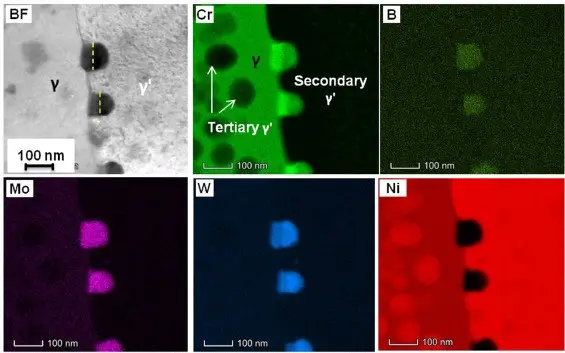
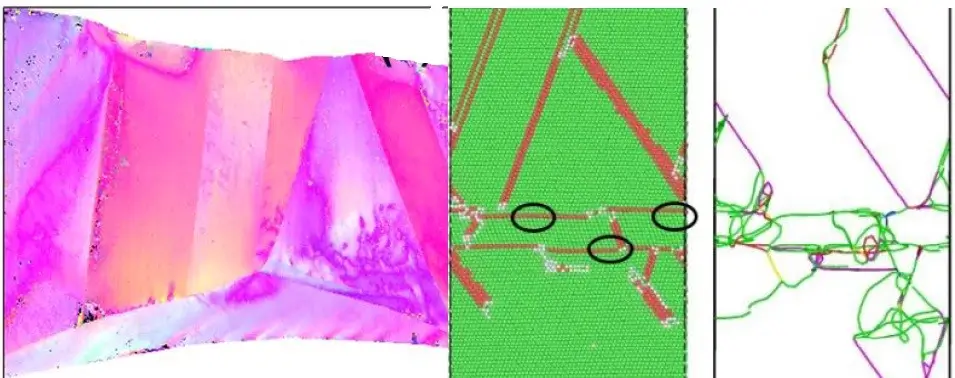
Prof. Prita’s research group has been working on investigating the links between the microstructure of metals and alloys and their plastic deformation, using a combination of experiments and modelling. Medium Mnsteels comprise the third generation of advanced high strength steels (AHSS), which have a combination of high strength and ductility. These properties are achieved by tailoring a twophase microstructure, which, during plastic deformation, undergoes deformation by multiple modes, namely twinning, phase transformation and dislocation slip. We show that both twinning and phase transformation can occur depending on the local composition of austenite grains (Fig 1) [2]. Ni based superalloy GTD444, is used to make directionally solidified blades for later stage turbines. Since Boron is added as a grain boundary strengthener, the microchemistry near boundaries and the crystallographic orientation of grains both influence deformation at elevated temperatures. We show that M2B type borides are present near boundaries, where M is Cr, W, and Mo (Fig. 2) [2]. These borides transform into M6C and M23C6 type carbides upon thermal aging, present discretely along the boundary, and prevent intergranular fracture. CuAl alloys are excellent model system to study solute strengthening and the effect of stacking fault energy, which reduces by an order of magnitude as Al content increases from 0 to about 8 wt%. Deformation of miniature tensile samples was carried out, and misorientation developed along twin and high angle boundaries measured (Fig. 3) [3]. This was explained based on molecular dynamics (MD) simulations of twinned crystals by observing dislocation accumulation near twin boundaries.
- Deformation of metals and alloys
- Microstructure evolution during deformation
- Dislocation dynamics simulations
- Molecular dynamics simulations
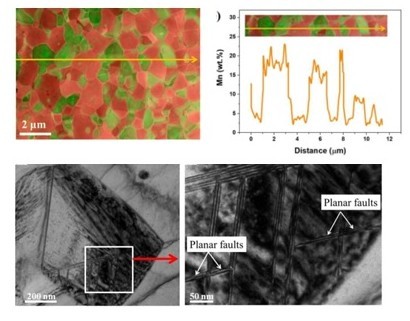
Mn distribution in austenite grains, when the average Mn is about 6 wt%. Intersection of planar faults, which are potential sites for martensite nucleation [1]
Nanoprecipitates at grain boundary present along the gammagamma prime interface. STEMEDS composition maps show the presence of Boron, and gradients in Cr and W [2]
Gauge section of deformed miniature tensile sample. Changes in colour show misorientation development. MD simulations of twinned crystal with green FCC coordinated atoms and red are HCP coordinated atoms. Dislocation accumulation at twin boundaries [3]
- Simultaneous Occurrence of Twinning and Phase Transformation During Yield Point Elongation in Medium Manganese Steels, P Satyampet et al. Metallurgical and Materials Transactions A 54 610 (2023)
- Compositionally Graded NanoSized Borides in a Directionally Solidified NickelBase Superalloy, Gupta, Richa et al., Scripta Materialia (2021)
- Misorientation Development at Σ3 Boundaries in Pure Copper: Experiments and MD Simulations, Sandhya Verma et al., Metallurgical and Materials Transactions A, 114 (2022)