
Professor
Nithyanand Prabhu
Email: nprabhu[at]iitb[dot]ac[dot]in
Phone: (+91) (022) 2576 7624
Education:
- Phd-Metallurgical Engineering and Materials Science, Carnegie Mellon University, Pittsbugh, 1991
- B. Tech Metallurgical Engineering, IIT Bombay 1985
In his teaching, Prof. N.Prabhu, lays emphasis on the fundamental concepts while simultaneously illustrating the principles with practical developments. Some courses taught are
Undergraduate Courses: Phase Transformations, Metallography Lab,
Heat Treatment Lab Postgraduate Courses: Topics in Phase Transformations, Xray Diffraction and Electron Microscopy, Characterization of Materials
The theme of Prof. Prabhu's research is "Processingstructureproperty relationship" in different materials. His research scholars have explored this relationship in Mg, Al, Tialloys and in steels viz., HSLA steel, Dualphase steel, Superduplex stainless steel and austenitic stainless steel. Currently he is collaborating with NMRL, Ambernath to develop suitable HighEntropy Alloy (HEA) for naval applications.
- Phase Transformations
- Electron Microscopy
- Physical Metallurgy
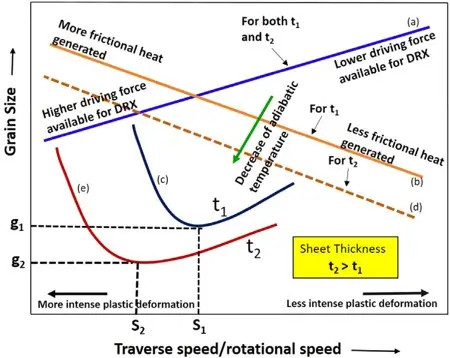
Microstructure evolution in friction stir processed 2507 super duplex stainless steel. Schematic diagram depicting the individual and synergistic effect of processing parameters such as heat input, strain rate and strain on grain size with respect to the traverse to rotation speed ratio and the thickness of sheet[1]
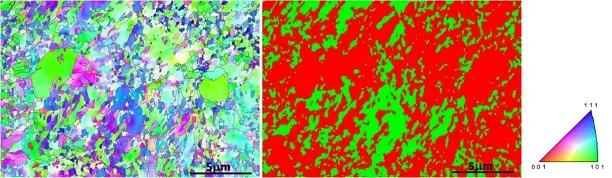
Strain induced martensite formation in 304 stainless steel. a) EBSDinverse pole figure map and b) phase map of austenite (70%) and martensite (30%) for the transition zone of SSI after tensile deformation, showing SIM association with micro shear bands. Red: Austenite, Green: Ferrite[2]
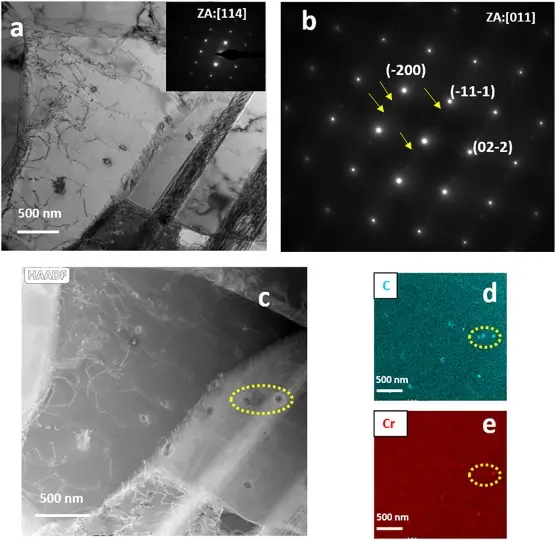
Friction stir processed, metastable, dualphase, Fe49.5Mn30Co10Cr10C0.5, multiprincipal element alloy (a) TEM bright field image showing the presence of M23C6 precipitates, (b) SAED pattern showing strong matrix reflections and weak precipitate reflections, (c) HAADF image showing the precipitates encircled in yellow colour (d) Xray elemental map showing the distribution of carbon and (e) chromium in the microstructure[3]
- M.K. Mishra, A.G. Rao, I. Balasundar, B.P. Kashyap, N. Prabhu, On the microstructure evolution in friction stir processed 2507 super duplex stainless steel and its effect on tensile behaviour at ambient and elevated temperatures, Materials Science & Engineering A 719 (2018) 82–92, doi.org.10.1016.j.msea.2018.02.032
- Sailaja Sharma, B. Ravi Kumar, B.P. Kashyap, N. Prabhu, Effects of concurrent strain induced martensite formation on tensile and texture properties of 304L stainless steel of varying grain size distribution, Materials Science & Engineering A 725 (2018) 215–227, doi.org.10.1016.j.msea.2018.03.099
- Neelam Meena, G. Gunasekaran, P. Veereiah, A.G. Rao, N. Prabhu, Corrosion behaviour of friction stir processed, metastable, dualphase, Fe49.5Mn30Co10Cr10C0.5, multiprincipal element alloy, Journal of Alloys and Compounds 952 (2023) 169967, doi.org.10.1016.j.jallcom.2023.169967