

Assistant Professor
Arka Mandal
Email: arkamandal[at]iitb[dot]ac[dot]in
Phone: +91-22-2576-7636
Education:
- Ph. D. Metallurgical and Materials Engineering, IIT Kharagpur, 2023
- M. S. Metallurgical and Materials Engineering, IIT Kharagpur, 2016
- B. E. Metallurgy and Materials Engineering, IIEST Shibpur (Erstwhile BESU Shibpur), 2010
In his teaching, Prof. Arka Mandal strives to break down fundamental concepts to the greatest possible extent, to help students understand why they study what they study.
Courses taught: Diffusion and Kinetics (PG)
Courses to be taught: Principles of Crystallographic Texture (UG/PG), Thermomechanical Processing and Forming of Steel (UG/PG)
Prof. Arka Mandal's research focuses on the deformation behaviour of metallic materials across length scales, from bulk response to nanoindentation, with emphasis on crystalline defects [1], solid-state phase transformations, and the processing-structure-texture-property correlation in steels. He employs advanced electron microscopy and related characterization techniques [2] to reveal the role of defects, interfaces, and microstructural evolution in governing mechanical behaviour. His work integrates experimental analysis with a fundamental understanding of deformation and transformation mechanisms to build structure-sensitive insights for metallic systems. A strong focus of his research is on steels, where texture evolution [3] and phase stability are linked to performance under service conditions. Overall, his research aims to connect microstructural features with macroscopic properties for the design of stronger, more reliable engineering materials.
- Deformation Behaviour of Metallic Materials Across Length Scales
- Advanced Electron Microscopy-based Characterization of Crystalline Defects
- Solid State Phase Transformation
- Processing-Structure-Texture-Property Correlation in Steel
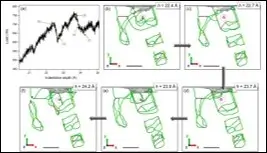
Spherical load vs. indentation depth curve shows the largest load dips, and dislocation structure beneath the indentation at incremental depths.
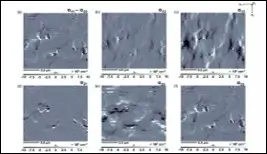
The HR-EBSD maps showing one difference of terms and five known terms of the Nye tensor: (a) α11−α22, (b) α12 (edge), (c) α13 (edge), (d) α21 (edge), (e) α23 (edge), and (f) α33 (screw), with the sample reference frame shown.
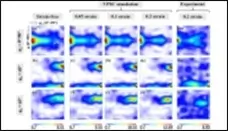
φ2 = 0°, 45°, and 65° sections of the orientation distribution function of FCC-austenite in strain-free, 0.05 strained (simulated), 0.1 strained (simulated), and 0.2 strained (simulated and experimentally obtained) conditions. Simulation is done in VPSC.
- A. Mandal, S. Biswal, S. B. Singh, D. Chakrabarti. (2025). Unlocking the synergy: How tip-radius and crystal orientation govern indentation in ferrous FCC Alloys. Materialia, DOI: 10.1016/j.mtla.2025.102621
- A. Mandal, B. Beausir, J. Guyon, V. Taupin, A. Guitton. (2025). Estimation of Dislocation Densities With Nondestructive Scanning Electron Microscope Techniques: Application to Gallium Nitride. Microscopy and Microanalysis, DOI: 10.1093/mam/ozae124
- A. Mandal, S. Morankar, M. Sen, S. Samanta, S. B. Singh, D. Chakrabarti. (2020). A Descriptive Model on the Grain Size Dependence of Deformation and Martensitic Transformation in Austenitic Stainless Steel. Metallurgical and Materials Transactions A, DOI: 10.1007/s11661-020-05861-7